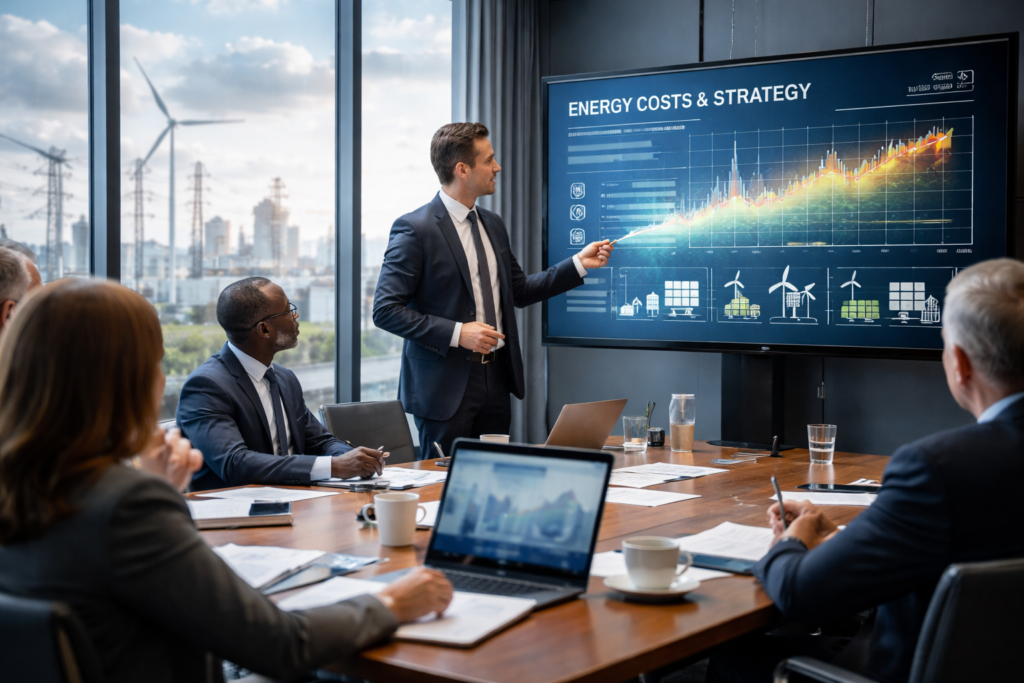
Corporate energy strategy is no longer a background consideration for US companies. In 2026, electricity costs, grid reliability, and power availability have become boardroom-level issues shaping how businesses plan growth, manage risk, and protect profitability.
For decades, most companies treated energy as a predictable operating expense — something handled by facilities teams and rarely discussed at the executive level. That era is over. Rising electricity prices, infrastructure constraints, extreme weather risks, and surging demand from AI and electrification have transformed energy into a strategic variable that directly affects competitiveness.
Today, companies that fail to understand their energy exposure are increasingly vulnerable. Those that do are gaining a measurable advantage.
The End of Energy as a “Background Cost”
Historically, US businesses benefited from a relatively stable electricity system. Power was affordable, outages were rare, and grid capacity generally expanded alongside economic growth.
In 2026, that assumption no longer holds.
Businesses now face:
- Faster-than-inflation electricity price increases
- Greater risk of outages during extreme weather
- Longer timelines for grid interconnection
- Regional capacity constraints
- Regulatory uncertainty around cost allocation
As a result, corporate energy strategy has shifted from cost management to risk management.
Energy decisions now influence capital planning, site selection, and long-term operating margins — not just monthly utility bills.
Rising Electricity Costs Are Reshaping Business Economics
Electricity prices are rising across much of the United States, but the impact on businesses is uneven.
Energy-intensive sectors — including data centers, manufacturing, logistics, cold storage, and healthcare — are feeling the pressure first. However, even office-based and service businesses are seeing higher costs through:
- Increased lease and operating expenses
- Higher cooling and heating loads
- Rising backup power and resilience costs
In competitive industries, small cost increases can determine whether expansion plans remain viable. For many companies, electricity is now one of the fastest-growing line items in operating budgets.
This has forced leadership teams to ask a question that was rarely raised before:
How exposed are we to energy risk?
Energy Availability Is Influencing Where Companies Invest
One of the most significant — and least visible — business trends of 2026 is the role of energy availability in investment decisions.
Companies planning new facilities are increasingly asking:
- Can the local grid support our power needs?
- How long will interconnection approvals take?
- Will electricity prices remain predictable?
- Are there reliability risks during peak demand?
In some regions, projects are being delayed, downsized, or relocated not because of labor shortages or permitting issues — but because electricity capacity cannot be guaranteed on the required timeline.
Energy constraints are quietly becoming a site-selection factor, alongside workforce availability, taxes, and real estate costs.
Power Purchase Agreements Go Beyond Big Tech
To reduce uncertainty, more companies are adopting long-term electricity procurement tools that were once reserved for utilities and tech giants.
Power Purchase Agreements (PPAs) are now being used by:
- Manufacturers
- National retail chains
- Logistics and distribution companies
- Commercial real estate portfolios
PPAs allow companies to:
- Lock in long-term electricity pricing
- Hedge against market volatility
- Improve cost forecasting
- Support new generation development
In 2026, corporate energy strategy increasingly resembles financial hedging — designed to stabilize costs rather than chase the lowest short-term price.
Reliability Is Becoming a Competitive Advantage
Outages used to be an inconvenience. Today, they can be a business liability.
Extreme heat, winter storms, and wildfire risk are increasing outage frequency in many regions. For businesses, power disruptions now mean:
- Lost revenue
- Supply chain delays
- Data and equipment risk
- Safety and compliance concerns
As a result, companies are investing more aggressively in:
- Backup generation
- Battery storage
- Microgrids
- Redundant power feeds
In some industries, the ability to remain operational during grid stress events has become a competitive differentiator — not just a resilience measure.
Utilities Are No Longer the Sole Architects of the Grid

Another structural shift is the changing relationship between utilities and large customers.
Historically, utilities controlled:
- Generation planning
- Infrastructure expansion
- Cost recovery
In 2026, large commercial and industrial customers increasingly influence:
- Where new generation is built
- How transmission is expanded
- Which grid upgrades are prioritized
Corporate demand — especially from data centers and industrial hubs — is reshaping grid planning alongside traditional utility forecasts. This shift has blurred the line between customer and system planner.
The Cost Allocation Debate Is Heating Up
As businesses drive electricity demand growth, regulators are facing growing pressure to answer a difficult question:
Who should pay for grid expansion?
In many cases:
- Large commercial users trigger infrastructure upgrades
- Costs are spread across all ratepayers
- Residential customers absorb higher bills
This has led to increasing scrutiny of whether current rate structures fairly allocate costs between households and large energy users.
For businesses, this introduces regulatory risk. Changes to access fees, demand charges, or cost-sharing models could materially alter long-term energy economics.
Energy Risk Is Moving Into Investor Conversations
Energy exposure is no longer just an operational issue — it is becoming a disclosure issue.
Investors and analysts increasingly want to understand:
- How sensitive a company is to electricity price volatility
- Whether grid constraints could limit growth
- How resilience is being addressed
- Whether energy strategy aligns with long-term planning
In 2026, companies without a clear corporate energy strategy stand out — and not in a positive way.
Operations, Workforce, and Energy Are Intertwined
Energy challenges ripple through daily operations.
Rising electricity costs affect:
- Shift scheduling during peak pricing
- Facility operating hours
- Worker safety during extreme heat
- Decisions around automation and electrification
For employers, energy strategy is now part of operational continuity and workforce planning — not just cost control.
What Energy-Smart Companies Are Doing Differently
Companies managing energy risk effectively tend to share common traits:
- They treat energy as a strategic input
- They engage early with utilities and regulators
- They diversify power sourcing where possible
- They invest in resilience before outages occur
- They incorporate energy assumptions into long-term planning
These organizations are better positioned to absorb volatility — and to capitalize on growth opportunities when others hesitate.
Looking Ahead: Energy as a Core Business Variable
The forces reshaping corporate energy strategy are not temporary.
Electricity demand will continue to rise. Infrastructure upgrades will take years. Weather volatility will persist. Regulatory scrutiny will increase.
In this environment, energy is becoming:
- A constraint on growth
- A source of competitive advantage
- A financial risk factor
- A strategic planning variable
Companies that recognize this shift early will adapt more smoothly. Those that don’t may find themselves reacting — expensively — later.
The Bottom Line
In 2026, corporate energy strategy is no longer optional. Electricity costs, grid reliability, and infrastructure access now influence where companies invest, how they operate, and how resilient they are in a volatile economy.
Energy decisions have become business decisions.
At US Energy Watch, we follow how energy trends intersect with corporate strategy, because the companies that manage power wisely today will be the ones best positioned to compete tomorrow.
Sources
Source: Analysis informed by publicly available data from the U.S. Energy Information Administration (EIA), utility investment plans, and US energy market assessments.